Convicted to Curious
I was never afraid of the beat I was on. I was afraid of the next one.
By Brian DiSabatino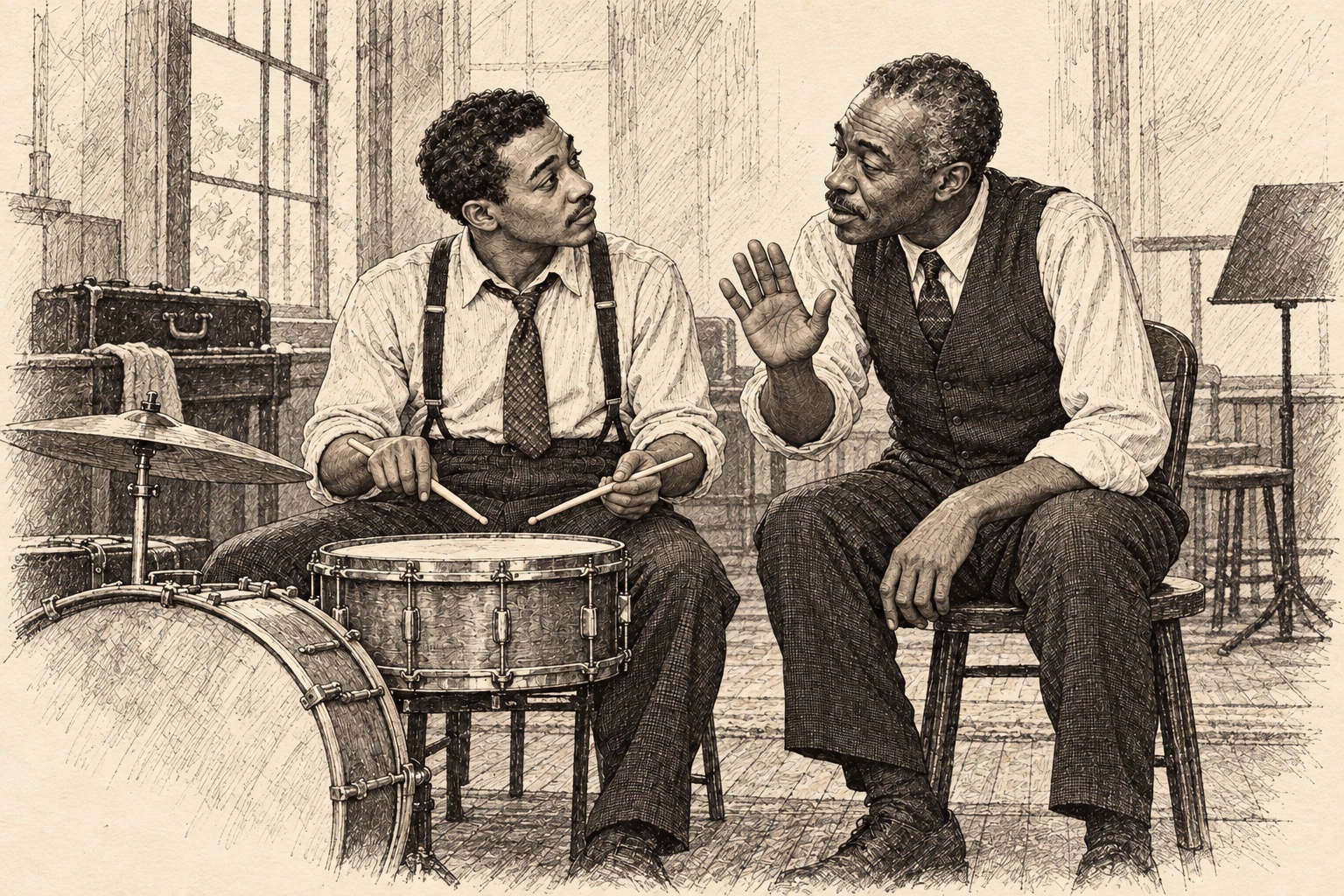
I need to tell you something I don’t put on my résumé. I was a percussionist at James Madison University, and I wasn’t a very good one.
I was a Marching Royal Duke from 1983 to 1987, and there were nights I held on to the composition for dear life. Some pieces were straightforward and I could ride them. Others spun me like a top. Brubeck’s Unsquare Dance, in seven, which no human being should be asked to count. The big band charts where the drummer is supposed to be the engine and I was mostly the brakes.
Here’s the honest version. I was never afraid of the beat I was on. I was afraid of the next one. Every rest felt like a trap. So I did what every bad drummer does. I filled it. I leaned on the downbeat, I came in early, I struck the drum like the answer was in the strike. If I could just get to the next note fast enough, I wouldn’t have to sit in the space before it.
It took Aaron Copland to teach me what I was doing wrong.
Fanfare for the Common Man is mostly air. Timpani, brass, and a lot of silence between them. The first time I played it, the rests terrified me. There was nowhere to hide. You strike, and then you wait, and the whole hall waits with you, and you have to trust that the next beat is coming whether you brace for it or not.
Flight of the Bumblebee is the opposite. Sixteenth notes flying, no room to breathe, famous mostly as a stunt. And here is what finally got through to me. Even in Bumblebee there is space between the beats. It’s tiny, but it’s there, and the good players live in it. The strike was never the hard part. The space was. That’s where the tension is, and that’s where the listening happens.
I didn’t get better by hitting harder. I got better the day I let a rest be a rest.
It took him eleven seconds, let me explain...
I told a leader I coach that his next season of growth was going to require moving from convicted to curious. The irony? He started explaining why he was so convicted before I finished the sentence. He went on to tell me that his industry moves too fast for that. His people expect him to have answers, that’s what they pay him for. He tried the open-ended-question thing at an offsite once and it went nowhere.
I let him finish. I chuckled. Then I said, “you just did it!”
He asked what I meant.
“That,” I said. “Right there. You never once asked me what I meant by convicted. You already knew. In eleven seconds you built a case, argued it, and closed it. You were so fast that you never found out whether I was talking about you at work or about the person across from you at your kitchen table.”
He got quiet. Which, for him, was the whole session.
I recognized him, because I’d been him. Not at a drum. In a boardroom. For years, my colleagues would have told you I was the leader who found what was missing, not what was there. Somebody brought me a plan and I had the hole in it before they sat down. I thought that was rigor. It was a drummer afraid of the next beat, striking early so nobody could surprise him.
Let me be clear about something, because I know who reads these.
Conviction is not the problem. I want leaders with conviction. I want the leader who’s been right an uncomfortable number of times and has the scar tissue to prove it. Strong opinions are the downbeat. Without them there’s no music, just drift.
But conviction without a rest written into it stops being strength and starts being fear with a confident face. The leader who can’t sit in the space between the question and the answer isn’t confident. That leader is afraid of what might arrive in the waiting. And the people around that leader figure it out long before the leader does. They stop bringing ideas. It feels like alignment. What actually happened is everyone stopped talking.
Brian Tracy has a line I first heard on a cassette tape in my car in the nineties, and I’ve leaned on it ever since. The expression was, “I might be wrong. I usually am.” It sounds like weakness. It’s the opposite. It’s a rest written into the score. It’s the only sentence I know that opens a door in a room that’s been sealed for a decade.
One of the best leaders I ever worked beside, in a meeting where I was tightening up and taking over, didn’t correct me. He asked, “Why are you acting this way?” One question. He could have delivered a verdict. He left a space instead, and I’ve been trying to answer him ever since.
So here’s what I’ve come to believe.
In leadership we have to make time for that space. Even when the work is flying at you like sixteenth notes, there’s room between the beats, and the leaders who grow are the ones who learn to stand in it. One more question before the answer. Three seconds after they stop talking... say it... “I might be wrong.”
That’s what I mean when I say slow down to the speed of espresso. Espresso isn’t slow. It’s small and intense, and it can’t be rushed or taken with you. It’s between the beats that we learn everything.
So, who stopped bringing you ideas? And the next time someone brings you a problem, can you let the rest be a rest?