Rising on the Wings of Angels
Wilmington, 1924. While the door closed on Italian immigration, the women of our family held it open.
By Brian DiSabatino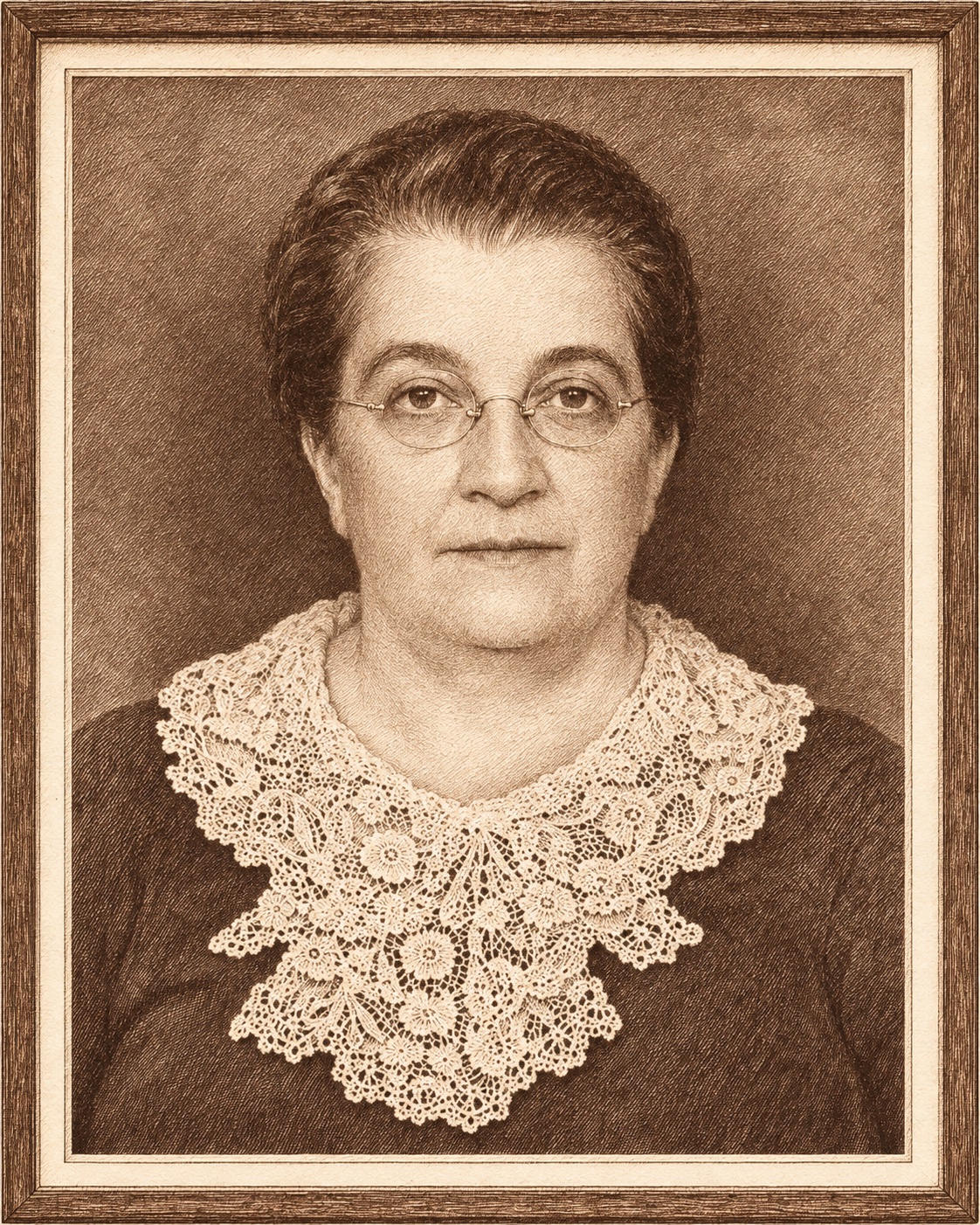
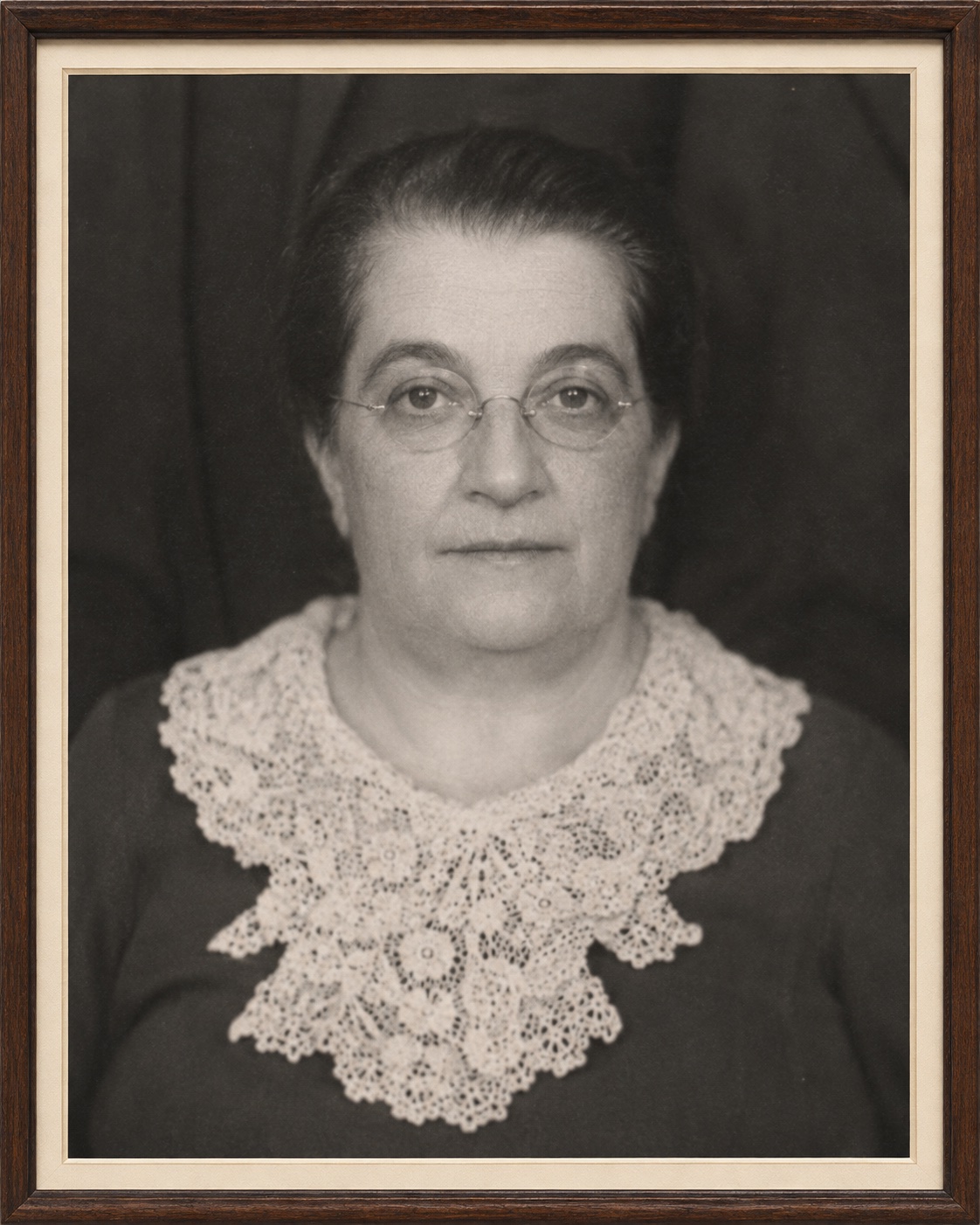
I never knew Angela Dea. She died in 1948, long before I was born, and I wish I had known her. I think if I had, I would better understand how Ernesto was even possible.
In a century of telling our family's story, we have neglected the power that the women brought to this catalytic, consequential, multigenerational work of cathedral building. The stories came down to us through the men: the stonemason, his sons, the company. Angela Dea left almost nothing in her own words.
I suppose the only way for me to reach Angela Dea and her daughters is through her daughter-in-law, my grandmother, Angelica.
Mom Mom
My grandmother, Angelica Petrillo DiSabatino, never wore pants. It was always a dress or a long skirt. She was beautiful and graceful, serious, and every so often wonderfully silly. She was the epitome of strength, stronger than most of the men I knew in our family.
What struck me, even as a boy, was the duality of her life. She was completely comfortable in the supporting role. She let my grandfather, Paul, have the attention, the traditional place as head of the household, the seat of the patriarch of the Paul clan. And she was the accountant, the planner, the quiet boss behind the scenes. She loved being a wife and a mother. She cooked and she baked. Somehow she convinced my grandfather to build a second kitchen in the basement, so the real work could get as messy as it needed to while a ceremonial kitchen sat in full view on the first floor for guests. Perhaps that was her metaphor. My guess is she really just wanted to keep cool in the basement.
Mom Mom, as we called her, would regale us with stories of riding in the dump trucks at the Petrillo quarries, the same quarries that would supply stone for St. Anthony's Church. Her father, Alessandro, was masterful and generous, and he ran the Petrillo empire with an iron fist. My guess is that he could do it because of the angels in his life: my grandmother and her sister, Lee Del Campo. To help her father, Mom Mom went to a small business school in Wilmington, Beacom College, and learned to keep the books. If it hadn't been for her comfort in that hardscrabble world of construction, among Italian laborers who spoke little English, she might never have met my grandfather or his sisters.
While researching this piece, I found her. On December 2, 1924, the Evening Journal reported the money Alexander Petrillo's team had raised that day for the new St. Anthony's Church, and it named the people who had actually gone out and collected it. One of them was Angelica Petrillo. A month later her name appears again among the women who furnished the kitchen of the new rectory. That young woman was Mom Mom, going door to door for her father's church, years before she became a DiSabatino. She turns up again in 1926, this time with her photograph, and I will come to that.
• • •
The Vote
To understand what women like her were doing in 1924, you have to understand how new their voice was.
In the Italy that Ernesto and Angela Dea left behind, voting had long belonged to a small circle of men who could pass a literacy test or pay enough in taxes. A stonemason from Sant'Omero almost certainly did not qualify. In 1912, while Italian conscripts were dying in the Libyan desert, Prime Minister Giovanni Giolitti pushed through a law that nearly tripled the electorate, from about three million voters to more than eight million. Nearly every adult man could now vote, including some two and a half million who could not read. Not one woman could.
In 1919 the Italian Chamber of Deputies voted to give women the ballot, but the government fell before the Senate could act. Three years later Mussolini marched on Rome. In 1925 his government granted a narrow local vote to women over twenty-five who met tests of education and taxes, and then abolished local elections before a single one of them could use it. The women of Sant'Omero would not vote in a national election until June 2, 1946.
In America the door to the ballot box opened sooner, though not without a fight, and not first in Delaware. In the spring of 1920 the whole country watched Dover, because Delaware could have been the thirty-sixth state, the last one needed to ratify the Nineteenth Amendment. On June 2, 1920, the General Assembly went home without doing it. Tennessee ratified instead that August, and American women won the vote anyway. Delaware did not ratify until March 6, 1923, a gesture made after the fact. And in 1922 Congress passed the Cable Act, which meant that an immigrant wife no longer became a citizen simply because her husband did. To vote, she had to claim citizenship herself.
So by January 1924, the Italian women of Wilmington held something their mothers and sisters in Abruzzo did not: a voice their government was bound to hear. And in those same months, that government was preparing to shut the door behind them.
This is a story about what they did with that voice. The newspapers of 1924 wrote the year in the names of men. But while the door was closing, the DiSabatino women, and the Italian women around them, were pushing back. They did not rest on their new freedom. They put it to work in this beautiful experiment called America: they protested, they organized, they raised money, they cooked, and they furnished the house. Above all, they held the door open for the ones still trying to come through. That passion is the disease of the stone, la malattia della pietra, and they planted it in us.
• • •
Prologue
In the first decade of the twentieth century, an average of two hundred thousand Italians came to the United States every year. They came from the hill towns of Abruzzo and the villages of Calabria and Sicily, carrying what they could carry. Many were men who came ahead of their families, meaning to send for them once they had work.
One of them was a stonemason from Sant'Omero named Ernesto DiSabatino. He arrived in 1906 with his two oldest sons. His wife, Angela Dea, followed that winter with the younger children on the White Star liner Cedric, and the family was held at Ellis Island before it could go on to Wilmington, Delaware. About a month after they were together again, one of their little girls died of diphtheria.
It is worth noticing who made that second crossing. Ernesto went first, with the older boys. It was Angela Dea who brought the little ones across an ocean and through Ellis Island to a city whose language she did not speak, and it was Angela Dea who buried a daughter that first winter. For the next forty years the newspapers would call her Mrs. Ernest DiSabatino. This is her story too, and the story of the women around her, though you have to read the small print to find them.
Wilmington then was a city of seventy-six thousand people, a factory town on the Christina River, ruled in its commerce and increasingly in its politics by a single family named du Pont. In 1900 there were 1,122 Italian-born people in the entire state. By 1910 there were nearly three thousand.
They settled in a few blocks on the west side of the city, around Lincoln and Union streets, and the newspapers began to call it Little Italy. In February 1907, weeks after Angela Dea arrived, the phrase made the front page of the Evening Journal. The occasion was a murder trial.
By 1919 the city had decided to make Americans of them. That December the Americanization Committee of the New Century Club, a Wilmington women's club, gave a mothers' party at the Italian Neighborhood House on Lincoln Street. The supper was planned to demonstrate American and Italian dishes. Angela Dea's daughter-in-law, Mrs. Clarence di Sabatino, made the macaroni. Angela Dea cooked the meat and made the sauce. While the supper cooked, the women drilled in English and in Italian. The club meant to teach. The paper's own account suggests that the lesson ran in both directions.
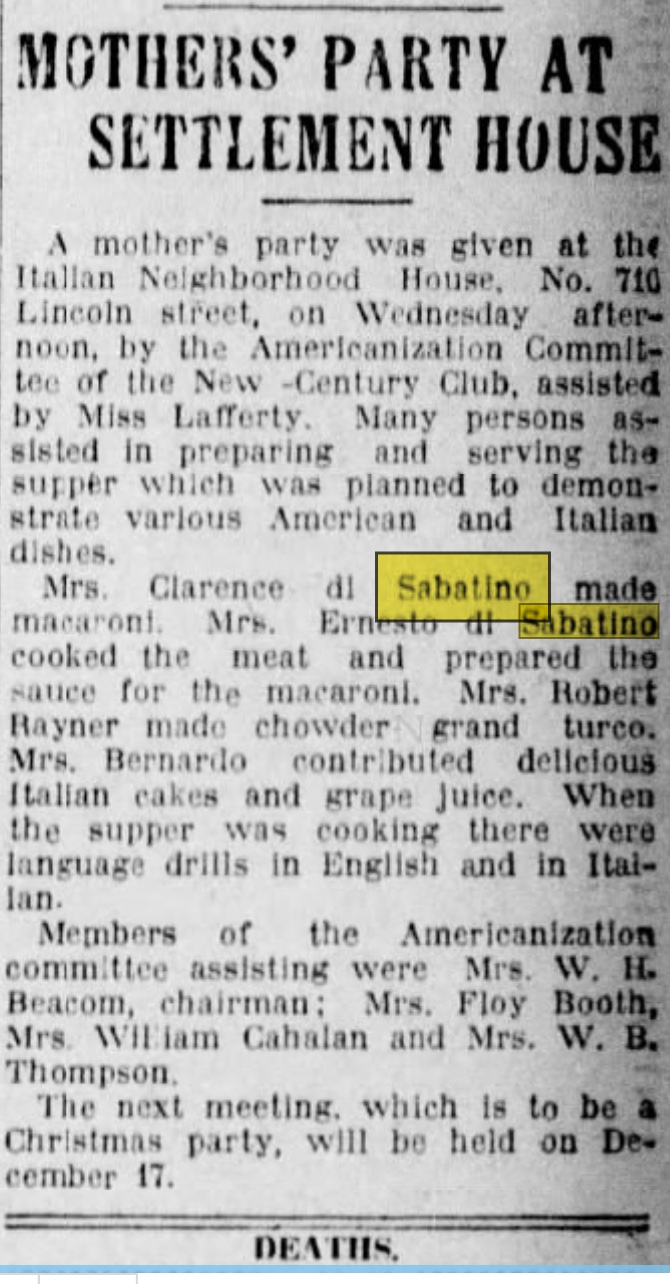
The committee's chairman that afternoon was Mrs. W. H. Beacom, wife of the man whose business school, Beacom College, would one day teach my grandmother to keep the books. Wilmington was a small place. Years later, the girl who learned bookkeeping at her husband's school would marry Angela Dea's son.
In 1924, seventeen years after Little Italy first made the front page, the country would decide it had seen enough of people like them. And the people of Little Italy would answer in the only language that has ever outlasted an argument. They would build.
• • •
Winter
The year began with a building permit.
On January 10, 1924, the Every Evening announced on its front page that the first large building permit of the new year had gone to DiSabatino and Sons: eight stores and dwellings on the east side of Union Street, between Tulip and Chestnut, at a cost of forty thousand dollars. It had been fifteen years since Ernesto took out his first known permit, for a fifteen-hundred-dollar house on Fifth Street. In 1906 he had been paid about three dollars for every thousand bricks he laid. Now his company's name led the city's building news.
Seventeen days later, on a Sunday afternoon, about two hundred women gathered at the Neighborhood Hall at 708 Lincoln Street. They had come to install a new lodge of the Order Sons of Italy in America, the second women's lodge in the city, called Stella D'Italia, the Star of Italy. Ernesto and his friend Anthony Corleto had escorted the order's officers down from Philadelphia. Three men from a Sons of Columbus lodge had done the organizing. But the fifteen officers who would run it, from the venerable to the treasurer to the door keeper, were all women, and the *Morning News* printed every one of their names. Among them was Ernesto's daughter, Splendora, as the lodge's assistant venerable.
There were speeches, as there always were. But the paper recorded something more. In Washington, Congressman Albert Johnson's immigration bill was moving toward a vote. It would sharply cut the number of Italians allowed into the country. The orators voiced their opposition to it. Then the lodge directed its state leader, the Grand Venerable, to send the order's opposition to the cutting of the Italian quota to the proper authorities in Washington.
We do not know whether anyone in Washington read it. We know only that two hundred women in a hall on Lincoln Street put their objection on the record. It ran on page four the next day, beside the news of the Teapot Dome scandal.
• • •
Spring
The door had been closing for some time. In 1921 Congress passed an emergency law capping each nationality at three percent of its population in the United States in 1910. Ernesto's nephews had come through just in time, and years later both of them told how, in their own words, to an oral historian named Francis Fierro.
Galileo was two or three hundred lire short of his fare in 1919 when a man back from Wilmington offered to make up the difference. "I know your relatives in Wilmington," Galileo remembered him saying. "All good, all honest. I give you two hundred lira right away." Galileo reached New York that December. As soon as he got to Wilmington he went to his uncle, and Ernesto paid the man back. About six months later, once Galileo had steady work, he repaid Ernesto.
His wife did not come with him. She was expecting their first child, and she waited in Sant'Omero to give birth before she sailed. Her crossing, in 1920, took three months. The ship was held in Naples over an unpaid repair bill, had to be towed into Gibraltar and sat there a month, then stalled in England when the crew went on strike, until the company sent another ship and moved the passengers onto it. Galileo met her in New York. Decades later he still had the telegrams. "I have all the telegrams," he said.
Valentino came in 1921. "I know exactly where to go," he said. "We had a little badge on our coat, 'Wilmington.'" At the station he asked a stranger for directions, a man he had never seen in his life but knew to be Italian. The stranger said, "I'll take you up there. I know very well," and walked him to his uncle's house.
The new law went further. On May 24, 1924, the Johnson-Reed Act was signed into law. It set each country's quota at two percent of its people living in the United States in 1890, a year chosen with care, because in 1890 the great migration from southern and eastern Europe had barely begun. Italy's annual quota fell from 42,057 to 3,845. In 1921 more than 222,000 Italians had come. In 1925, about 6,200 did.
Valentino saw the door narrowing and went through it the other way. In 1924 he and a cousin who worked for their uncle sailed home to Sant'Omero to marry. "That time there was a certain law that we could go and bring back wife," he told Fierro, and the transcript notes that he laughed. They were married within twenty-nine days and came back with their brides. He does not tell us their names. Twenty years later, after the family had spent two decades in Ohio, it was his wife who decided they would come home to Wilmington. He said it plainly: "My wife decided to come back to Wilmington."
The language of the day made the reasoning plain enough. The Wilmington papers had long written of Italians as a problem to be managed. In 1910 a front-page story explained that two Italians in a shooting had, "like most of their fellows," joined the Black Hand societies said to be popular in their country. In 1921 an Every Evening headline spoke simply of "the alien problem."
And there were men in white robes. By the summer of 1921 the Ku Klux Klan had organized five chapters in Delaware, preaching against Catholics and foreigners and casting itself as the guardian of Prohibition. Not everyone in Delaware stood for it. On the last night of August 1923, a crowd of several hundred stormed a Klan rally in a field outside New Castle, tore down the burning cross, and drove the Klansmen from the field. Half a dozen men were shot.
In Little Italy that spring, the work went on. Somewhere on Union Street, between Tulip and Chestnut, eight new storefronts were rising.
• • •
Summer
Tedaldo DiSabatino was thirty-three years old. Like Ernesto, he had come from Sant'Omero. He had served his new country in the Great War as a wagoner with the 312th Ammunition Train, and in February 1919 he came home across the Atlantic on the transport Sierra. He worked as a bottler and lived at 102 West Fifth Street, a short walk from Ernesto's shop at Fifth and Lincoln.
On June 30, 1924, at Third and Union Streets, he was shot and killed by Prohibition agents.
The next morning the Morning News reported that "feeling" in the Italian community had been "aroused." The Sons of Italy sent a committee to the state's attorney general to ask for an accounting. Ernesto, the best-known builder in Little Italy to share the name, told the paper the dead man was no relation and that he had known him only slightly. That was true. But it is worth sitting for a moment with why the statement was needed at all. In the summer of 1924, a man with an Italian name could be killed a few blocks from home, and a builder who shared his name ended up in the same story, telling the paper the dead man was not his kin.
We have not found a record of what the attorney general told the committee, or whether anyone answered for Tedaldo's death. The record, for now, goes quiet.
That same summer the quota law took effect. On July 1, 1924, the day the Morning News carried the story of the shooting, the new limits on immigration began to govern who could come. The door Ernesto had walked through in 1906 was now, for most of the people of Sant'Omero, closed.
• • •
Advent
In December the neighborhood answered the year the only way it knew how.
Little Italy did not yet have a parish church of its own. Father J. Francis Tucker meant to change that. From headquarters at Salesianum he ran a drive called Donation Week to raise a church for St. Anthony of Padua, with teams led by men from the neighborhood and the running totals reported in the papers.
On December 3, 1924, page ten of the Morning News carried four photographs side by side: Del Campo, Petrillo, Ernest Di Sabatino, and Fidance, the men leading the drive. By the second day the campaign had raised $18,598, with $4,998 of it coming in a single day. Ernesto's corps of workers brought in $830 that day.
The gifts were not all money. Alexander Petrillo pledged $1,000, and then the excavation, and then the foundation stone itself. Laborers who had little cash to give pledged their hands instead, one hundred days of work. A church would be built the way the neighborhood itself had been built: by people who knew how to dig, and lift, and set stone.
The headlines went to the men. The women are in the small print. The $1,069 that Alexander Petrillo reported on the second day, the Evening Journal noted, had been collected by Mr. and Mrs. Fortunato Pileggi, Mamie d'Alonso and Angelica Petrillo, my grandmother. Two days later a little girl named Rose Caruso, of 705 West Ninth Street, carried her Christmas bank to Father Tucker's office. It held five dollars in nickels, dimes and pennies, and she gave it, the paper said, "to St. Anthony instead of Old Kris."
On the last day, December 8, the front page read "Di Sabatino Team Highest for Day." Ernesto's teams had brought in $2,328, working from New Castle to Squirrel Run, and had equalled a record every committeeman in the drive had been chasing: they beat Father Tucker's own total, something only Petrillo's teams had managed before them. By that afternoon the fund stood at $44,640, and Tucker expected to reach fifty thousand by midnight.
On Christmas Eve, 1924, the first Midnight Mass was said in a temporary chapel. There was no church yet. There was only a year that had begun with a protest sent to Washington, passed through a law that closed the door and a death on a street corner, and ended with a congregation kneeling together in a makeshift room, waiting for something they had decided to build.
• • •
Epilogue
Early in January 1925, about two hundred women of the parish came to the rectory for a kitchen and linen shower for Father Tucker and Father Paul M. Fournier. They came from the Brick-Ex, from the Eleventh Street bridge district, from Shellpot and Claymont. They furnished the kitchen completely and brought a dinner set, silver, table linens and glassware. Refreshments were served, the paper noted, "the coffee being made on the new stove." Many of the husbands were present.
The list of women in charge fills most of a column. Mrs. Ernest Di Sabatino is on it. So are her daughters-in-law, Mrs. Arthur, Mrs. C. and Mrs. D. Di Sabatino; Mrs. M. Fidance, who was her daughter Splendora; a Miss C. Di Sabatino, very likely her daughter Clelia; and Angelica Petrillo, who had helped collect for her father's team a month before. The men had pledged the stone. The women made a home for the priests who would serve in it.
On March 8, 1925, ground was broken for St. Anthony's. Nearly four thousand people came. The papers reported that Father Tucker wept.
In April 1926, two months before the new church was dedicated, the Every Evening ran a photograph of Angela Dea, in a decorative frame, with her name above it. She was a patroness of the annual dance for the benefit of St. Anthony's, given at the New Century Club, the same women's club whose Americanization Committee had once invited her to cook for a mothers' party. The caption described her as "one of the most interested workers in St. Anthony's Church affairs." It is the only photograph of her we have found in print.
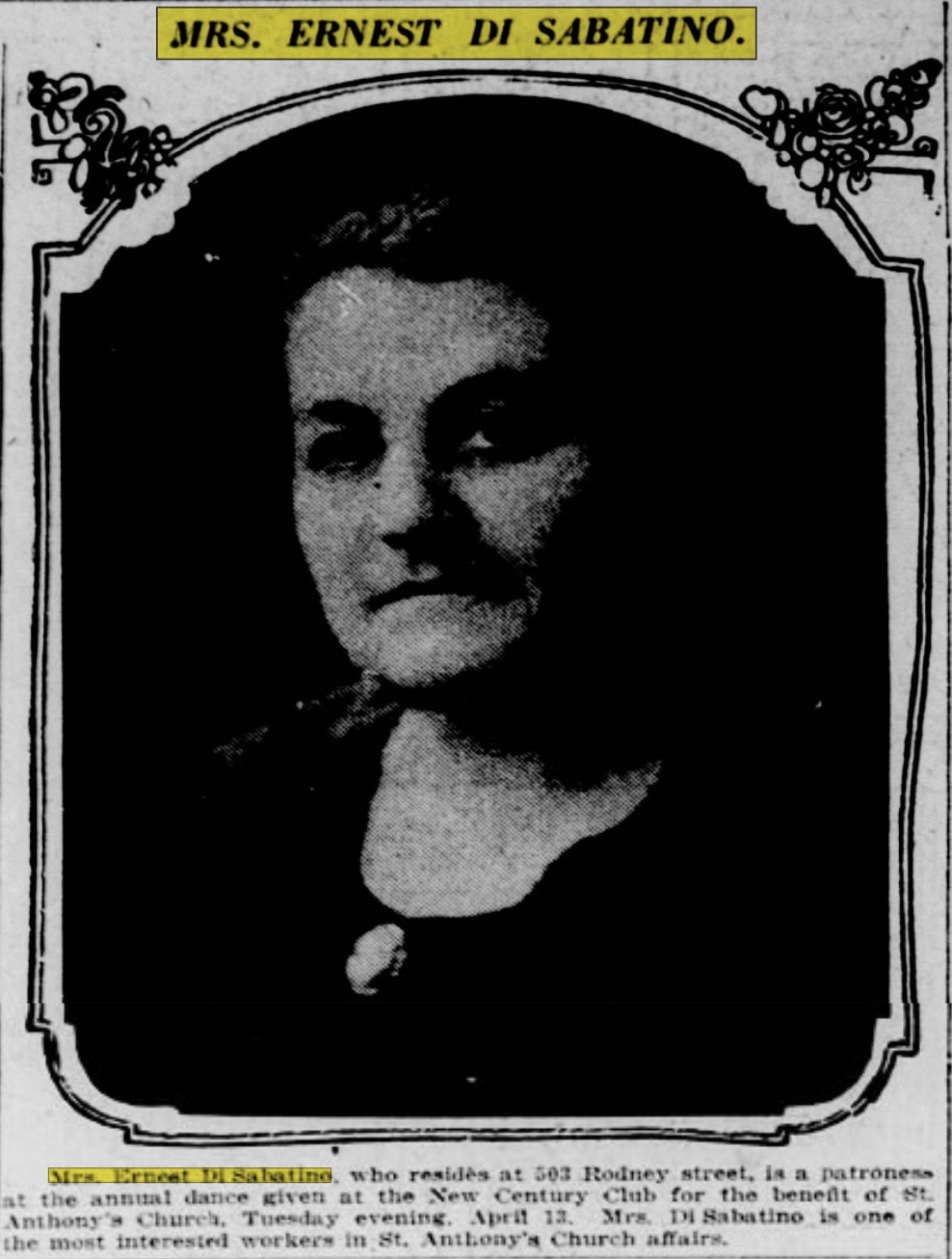
Twenty years after she was held at Ellis Island, Angela Dea's face was in the Wilmington paper. Seven years after she cooked the sauce for the New Century Club's Americanization supper, she was a patroness at the club itself. She did it while she could barely speak English.
And I have to believe she carried that first winter into every one of those rooms. A mother does not stop grieving a daughter because the years go by. I suspect there were nights on Rodney Street when she wondered whether the crossing had been worth what it cost her. The record cannot tell us that. What it tells us is what she did anyway.
She had not left Little Italy to get into those rooms. She brought it with her, and she was raising money for its church. What she and Ernesto were building would outlast them both by generations.
Three days after Angela Dea's photograph appeared, the Evening Journal ran another one, for the same dance. It was a portrait of Miss Angelica Petrillo, daughter of Alexander Petrillo of Shellpot Quarries. The dance at the New Century Club, the paper said, had been arranged by four young women of St. Anthony's, and Angelica was its general chairman. She was "one of the most popular of the younger members of St. Anthony's." Helping her were Carmela Del Campo, Adaline Pennetto, and Clelia Di Sabatino, Angela Dea's daughter.
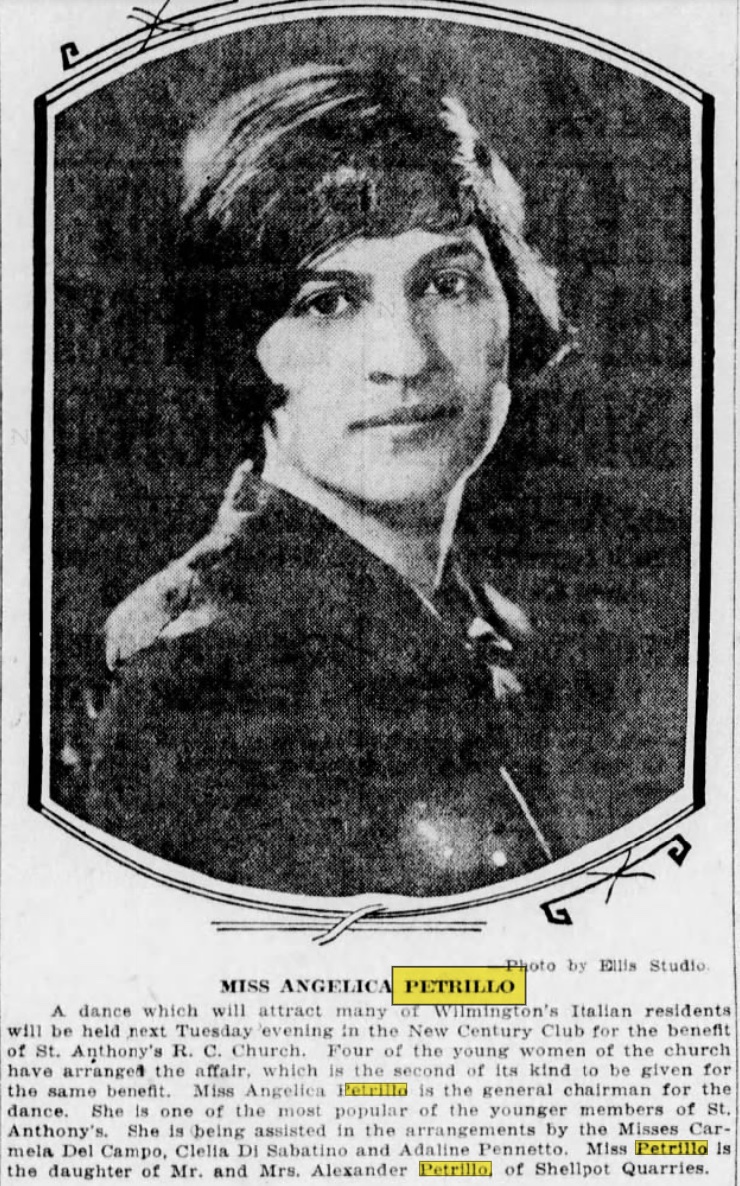
So on the evening of April 13, 1926, in the clubhouse of the women who had once set out to Americanize them, Angela Dea was among the patronesses and Mom Mom was the chairman. Nearly three years later, on February 6, 1929, Father Tucker married Angelica Petrillo and Paul DiSabatino at St. Anthony's. Her sister Olympia was maid of honor. Paul's sister Clelia was a bridesmaid, and his brother Joseph was best man.
On June 13, 1926, the church was dedicated, and a golden key opened its doors.
The quota system that took hold in 1924 would govern American immigration for the next forty-one years, until Congress set it aside in 1965. By then Ernesto was long gone, and most of the people who crowded the groundbreaking or met that January night on Lincoln Street had followed him.
The church still stands.
The newspapers of 1924 wrote the year in the names of men: the congressman, the agents, the builders in the photographs on page ten. Beneath that history the small print keeps a second one. Two hundred women sent their objection to Washington. A little girl gave up her Christmas money. Women went door to door and let the men report the totals. And when the stone had been pledged, two hundred more came with linens and a dinner set, and made the coffee on the new stove.
Angela Dea outlived Ernesto by sixteen years. When she died in May 1948, at eighty-one, her obituary noted that she belonged to the Holy Rosary Sodality of St. Anthony's. Her requiem Mass was sung there, in the church she had worked for. And above the notice, for once, the paper printed her own name.