Three Dollars a Thousand
How a stonemason from Sant'Omero built a company, and a neighborhood, in Wilmington.
By Brian DiSabatino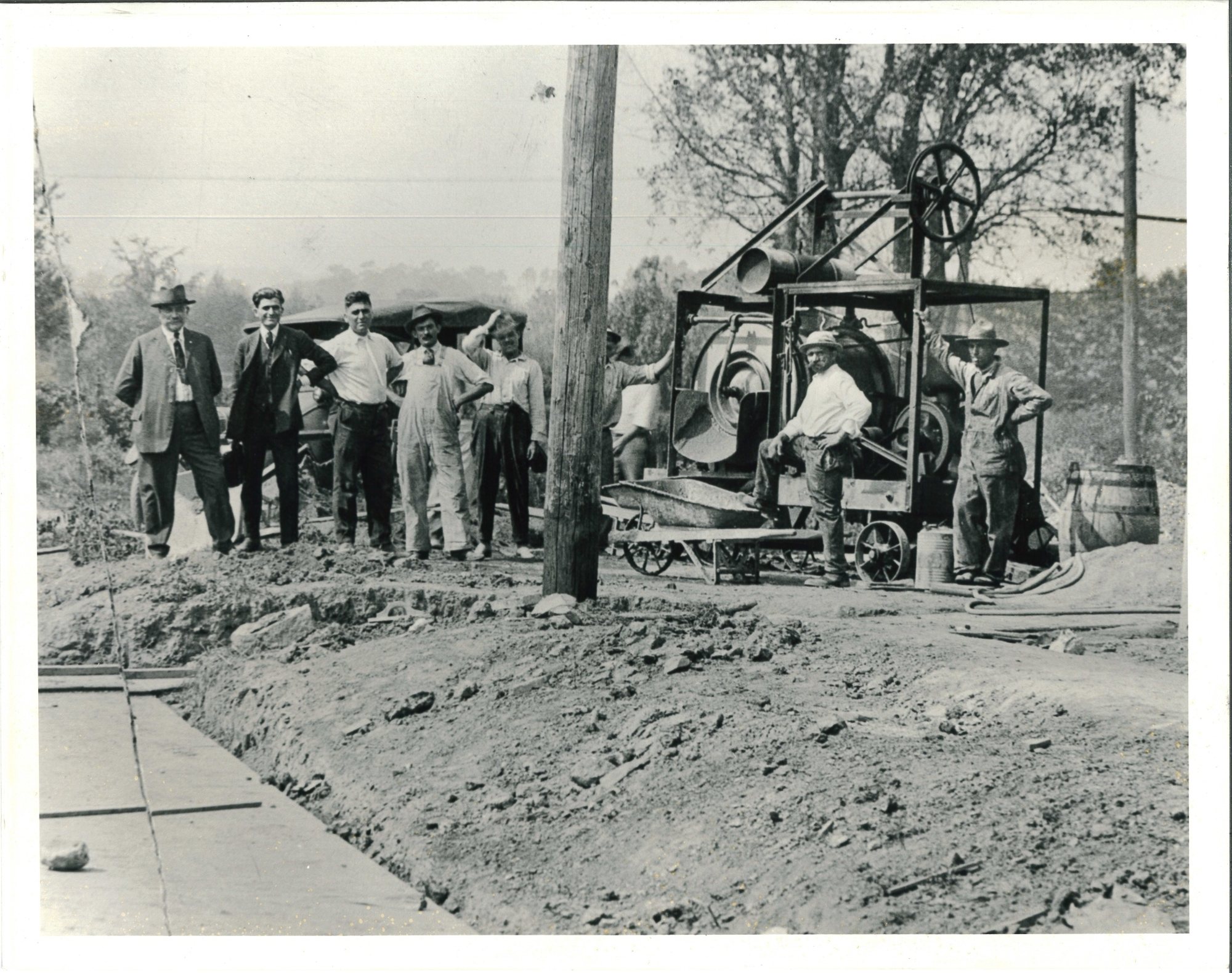
There is a photograph in our family I keep coming back to. Four men stand at the left edge of a job site: my great-grandfather Ernesto in a suit and fedora, and beside him his sons Dominick, Clarence and Arthur. Arthur wears overalls with his necktie still knotted. To their right, the crew leans on a concrete mixer, and in front of everyone is a trench and a fresh pour of concrete. Half office, half field. That was the company, and in a way it still is.
Every builder I know remembers the first job. Not the biggest one. The first one.
For Ernesto it was a three-story house at Fourth and du Pont streets, built for a man his son remembered as Gingabach. He was paid about three dollars for every thousand bricks laid. 1 Lay a thousand bricks and you have a full day behind you and a sore back to prove it.
• • •
He did not come to America as a contractor. He came as a stonemason who had cut rock in the Simplon Tunnel under the Alps. 1 When he reached Wilmington in 1906, he and his sons took work wherever it was. Dominick remembered his brothers working for Hamilton and Company and for Peninsula Cut Stone. 1 Ernesto's obituary says he spent three years working for a local contractor named Talley. 2
His grandson Gene, Dominick's son, described those first years in a 2003 interview. Row houses were going up all over Little Italy, and Ernesto, Arthur and Clarence went from contractor to contractor asking if anyone needed brickwork. They were paid by the piece, so much per thousand bricks. A laborer or two mixed the mortar, and the three of them laid brick from dawn to dusk. The more bricks they laid, the more money they made. One of the first contractors they worked for, Gene recalled, was a man named Kraft who was building houses along Fourth Street near Lincoln. 17
His first try at running his own outfit did not last. Dominick said Pop went into partnership with two friends, old man SanCantera and Pasquale Cedi, and it came apart in two or three months. 1
So he tried again, this time with the people he trusted most. According to his obituary, he organized Ernest DiSabatino and Sons in 1909, with his sons as his partners. 2 The company has dated its founding to 1908 for as long as any of us can remember. I'm content to let the family argue that one out over dinner.
• • •
The building inspector's reports let you watch him climb.
In August 1909 the inspector issued Ernest DiSabatino a permit to build a $1,500 house for Frank Toscani on Fifth Street between Lincoln and Union. 3 By 1912 he was buying and selling lots on Union Street near Eighth. 4 In February 1920 his name was on the front page as builder of a $50,000 motion picture theatre on Union Street between Third and Fourth, for the West End Amusement Company. 5 In 1922 it was a store and dwelling at Davis and Claymont streets. 6 And in January 1924 the front page announced "Building Project Will Cost $40,000." DiSabatino and Sons had received the first large permit of the new year, for eight stores and dwellings on the east side of Union Street between Tulip and Chestnut. 7
Look at those addresses. Fifth and Lincoln. Union Street, again and again. Fourth and du Pont. He was building the neighborhood he lived in, for the people he went to Mass with.
The business itself lived in those same few blocks. Gene remembered the shop as an old stable in the middle of the block between Fifth and Sixth, Lincoln and Union, with the office on the corner of Fifth and Lincoln, steps from the house the family built at 501 Lincoln. Every morning the men gathered there to learn where they were working that day and to be driven to the job. 17
It grew from there. The company took on concrete, then carpentry, and moved its office downtown to 839 Tatnall Street. At its peak, Gene said, it was a large masonry outfit with as many as 250 bricklayers when the work was there. Dominick ran the office and did the estimating, though he had only gone through the sixth grade. Gene said it was something to watch him work with so little schooling. 217
People outside the neighborhood noticed. In September 1925 he was named to the executive committee of a $500,000 campaign for the Physicians' and Surgeons' Hospital, a committee chaired by Irénée du Pont, with Mrs. E. Paul du Pont and Miss Amy du Pont serving alongside him. 8 In 1930 Josiah Marvel stood up at a banquet and called him one of Wilmington's greatest home builders. Marvel added that Ernesto earned the title not only for the houses he built, but because he saw that children needed training at home and in church to grow into good citizens. 9
• • •
Those years were not always kind to an Italian name.
On June 30, 1924, federal prohibition agents shot and killed a 33-year-old bottler named Tedaldo DiSabatino at Third and Union streets, a few blocks from the family shop. Like Ernesto, he was born in Sant'Omero. He had served in France in World War I as a wagoner with the 312th Ammunition Train and come home in 1919. 181920 The Italians of the West End were furious, and the Sons of Italy sent a committee to the attorney general. Ernest DiSabatino, a local contractor, told the paper the dead man was no relation and that he knew him only slightly. 10 He was right. The two families shared a hometown and a name, and nothing more.
Two years later, in May 1926, the front page reported that the United States attorney had named Ernest di Sabatino as the owner of 210 North Union Street in a prohibition "padlock" suit to shut the place down. Three days later the government filed an amended complaint naming a different owner, Gregorio Papaleo, and the paper reported that this exonerated Ernesto entirely. 1112
I read those two stories as a small window into how easily an Italian name could be dragged into trouble in those years. He answered the way builders answer. He kept building. That same year he had a permit for a $5,000 addition at 204 North Union, and the next year another job on South Union. 1314
• • •
Ernesto died in 1932. Six years later, his sons finished the seven-story building at 200 West Ninth Street, at Ninth and Orange, built by Ernest DiSabatino and Sons. The paper called it an impressive addition to the city's skyline. 15 By then two of his grandsons, Ernest Andrew and Ernest John, were studying civil engineering at the University of Delaware. 16
The story behind it is one of my favorites. In 1929 the Fidelity Bank and Trust Company announced plans for a new bank and office building on that corner, designed at fifteen stories and approved at twelve. 21 Ernest DiSabatino and Sons was the contractor. By June 1930 the company had finished the excavation and the foundation, and the steel was being fabricated in Pittsburgh. 22 The steel never came. The Depression caught the bank first. In July 1931 its property at Ninth and Orange was sold at a foreclosure sale, and that fall a petition in Chancery Court alleged the bank was insolvent. 2324 Exactly how the lot passed from that sale into the family's hands is a gap I haven't been able to fill, and since we sold the property decades ago, I may never fill it. The family has always told it simply: rather than walk away unpaid, we took the site. The 1938 paper says the DiSabatino Holding Company acquired it in 1931, while Ernesto was still alive. For six years the finished foundation sat as a hole full of weeds and trash, until in the fall of 1937 the brothers decided to build on it themselves. 15
The ad the paper ran when the building opened says it in three words: Builders and Owners. The building was modern in every way, but the detail the paper made a point of was the drinking water, chilled by a Frigidaire unit and served from fountains on every floor. Even the concrete was family. It came from A. Petrillo Co. Alexander Petrillo, the man who gave the foundation stone for St. Anthony's, Little Italy's parish church, was by then my grandfather Paul's father-in-law. 15 The company that started at three dollars a thousand bricks had become a developer, not by plan but because it refused to leave a job unfinished.
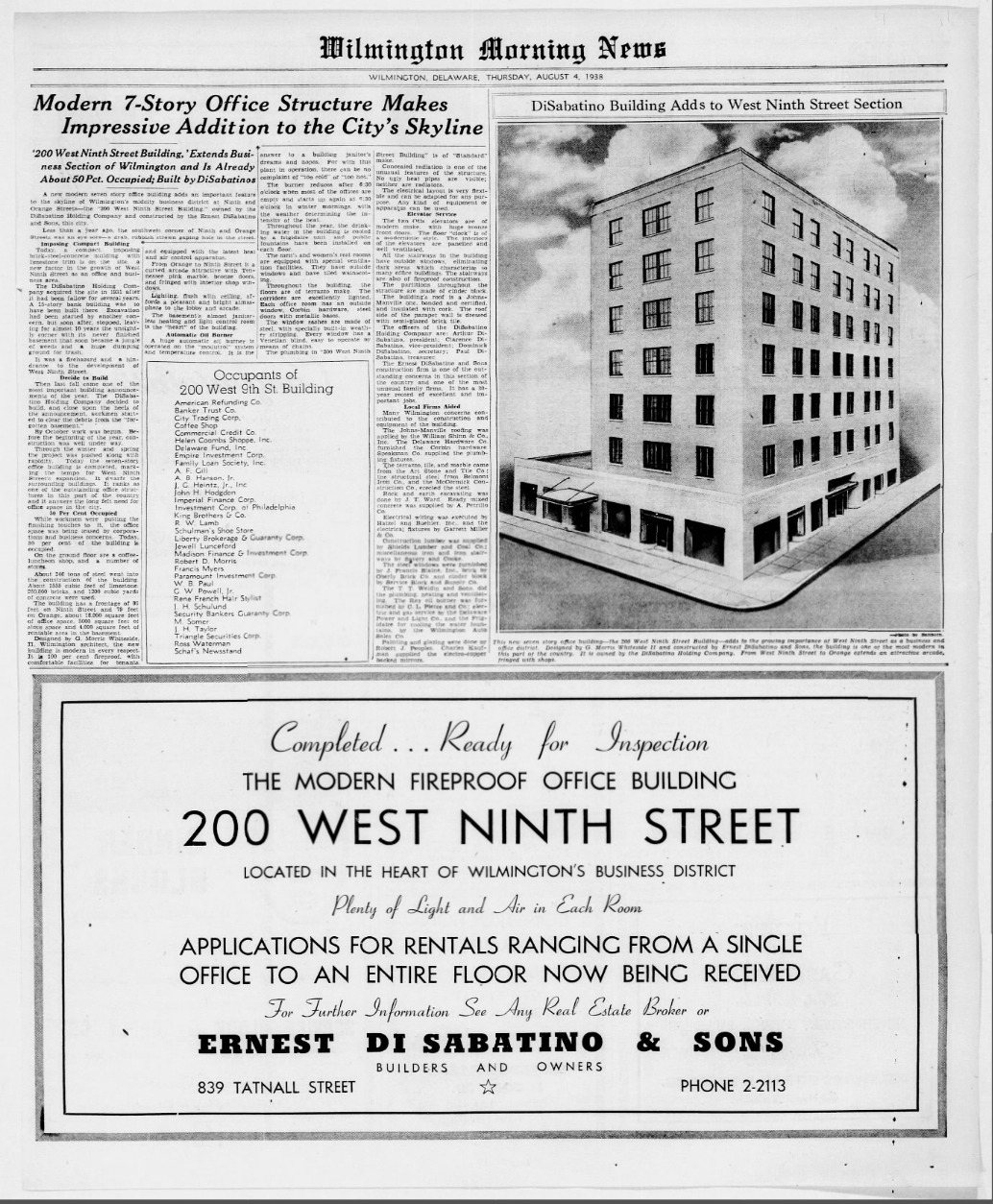
Three dollars a thousand to seven stories, in a single generation.
Ernesto's influence did not stop with one company. After World War II the family business divided. In 1946 Arthur left Ernest DiSabatino and Sons, and his son, Ernest J. "Ernie" DiSabatino, joined with Fritz Ranier to form DiSabatino-Ranier. 17 That company is still building today as DiSabatino Construction. Two companies, both still at work, grew from one stonemason from Sant'Omero.
Here is what I take from it. The first partnership failed because it was built on convenience. The second one was built on trust, with partners he would see at the breakfast table every morning. It has lasted more than a century, and it inspired yet another highly successful company in DiSabatino Construction. Bricks were never really the product. The product was a family you could count on and a reputation you could build on. Everything else was masonry.
So here is my challenge to you. Like Ernesto, how will you take the broken stones lying at your feet, put them together with the people around you, and build your cathedral?